Short stack vs deep stack: strategy adjustments. Mastering poker requires adeptness in navigating both deep and short stack scenarios, each demanding distinct strategic considerations. Whether you find yourself in a cash game with a deep stack or battling through the later stages of a tournament with a short stack, understanding how to adjust your approach and strategy is crucial for success.
Here are some detailed guidelines to consider for playing effectively with both short and deep stacks.
Short Stack Strategies: Precision and Aggression
Selective Hand Play:
Playing with a short stack, typically under 20 big blinds, necessitates a highly selective approach to hand selection. The diminished value of small pairs and suited connectors, due to limited stack depth, shifts the focus towards hands with high card strength that can dominate the ranges opponents are likely to call with. For instance, an all-in push with A-10 from the button can be highly effective, especially when blinds are likely to fold, maximizing your chance for a steal.
Shove/Fold Dynamics:
The essence of short-stacked play revolves around the critical decision to shove all-in or fold. Utilizing shove/fold charts becomes invaluable, offering a guideline on when to push aggressively with hands like K-Q offsuit from the cutoff, a move often recommended in these charts for its fold equity and potential to double up.
Maximizing Fold Equity:
Enhancing fold equity is crucial when playing short-stacked. Initiating the action by being the first to shove often compels opponents to fold, particularly effective in situations like shoving from the small blind to steal blinds and antes, thereby conserving or slightly building your stack without contest.
Deep Stack Poker: Strategic Depth and Flexibility
Understanding Deep Stack Dynamics:
In deep stack situations, where stacks are significantly larger than 100 big blinds—common in cash games and deep stack tournaments—the game offers a broader scope for strategic play.
Preflop Bet Sizings:
Your open-raising sizes should mirror those used in standard play, maintaining consistency. Adjust your 3-bet size when in position to exploit the advantage of acting last, making it more challenging for your opponent to navigate the hand postflop. Conversely, when out of position, consider increasing your 3-bet to 10 or 11 big blinds to leverage a larger pot from a stronger strategic stance.
3-Betting and 4-Betting Ranges:
When playing deep stack in position, your 3-betting range may not require too much adjustment; it’s your opponent who must adapt. But when playing out of position, polarize your range more, incorporating suited connectors for improved board coverage and leveraging suited Aces for their big pot potential in flush scenarios. Adjust your 4-betting strategy to focus more on flat calling with hands like QQ and AK, managing the pot size for strategic postflop play.
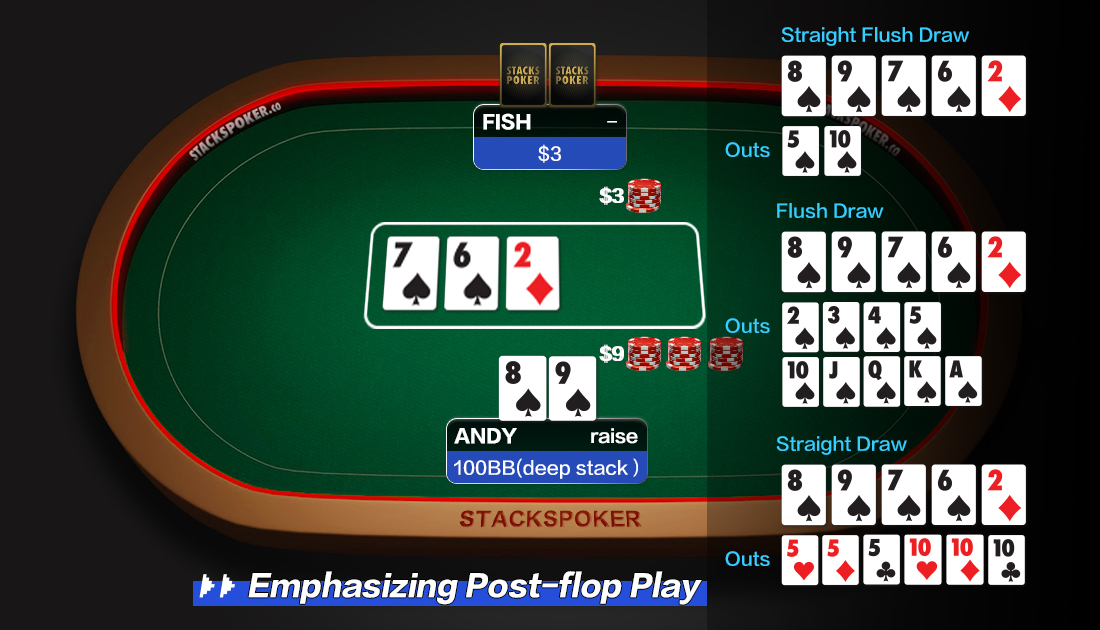
Emphasizing Post-flop Play:
Deep stack play, with stacks over 100 big blinds, shifts the game’s focus significantly towards post-flop play. Comfort and skill in navigating the flop, turn, and river, backed by a deep understanding of opponents’ tendencies and hand ranges, become paramount.
A scenario like calling a pre-flop raise with 8♠9♠ and facing a 7♠6♠2♥ flop illustrates the strategic depth of deep stack play, where opting for a check-raise with a strong draw or calling to see the turn cheaply can dictate the hand’s direction. The most significant adjustment in deep stack play is in 3-bet pots out of position, where adopting a more defensive strategy is prudent. Opt for a balanced mix of checking, calling, and selective betting to navigate these situations carefully.
Leveraging Implied Odds:
With deeper stacks, implied odds gain importance, allowing calls with hands that might not be immediately profitable in shorter stack situations due to the potential for significant wins.
An example is calling a raise with 5♦5♠, which may not appear profitable with a short stack but offers the chance to win a large pot by hitting a set against an opponent’s strong hand in deep stack conditions.
Bluffing and Semi-Bluffing:
Bluffing becomes a nuanced, multi-street strategy in deep stack play. Initiating bets not only to claim the pot immediately but also setting up future bluffing opportunities is key.
For instance, semi-bluffing with A♠J♠ on a Q♠10♠2♦ flop allows for aggressive continuation bets on later streets, maintaining pressure on opponents and potentially securing the pot without showdown.
Adjustments Between Short and Deep Stack Play
Navigating poker successfully requires adept adjustments between short and deep stack strategies, each with its unique set of considerations for risk management, leveraging position, and understanding stack-to-pot ratio (SPR).
Risk Management:
– Short Stack Play: When playing short-stacked, typically defined as having fewer than 20 big blinds, your risk is inherently capped due to frequently facing all-in or fold decisions. This binary choice simplifies risk management but also limits your play to seeking opportunities for maximum impact with minimal decisions.
– Deep Stack Play: Conversely, with deep stacks (100 big blinds or more), managing risk becomes a more complex, nuanced task requiring careful consideration over multiple betting rounds. The potential to lose significant portions of your stack without going all-in necessitates a sophisticated approach to hand selection, betting strategy, and pot commitment.
Leveraging Position:
Position’s importance transcends stack sizes but becomes particularly critical in deep stack play. With a deeper stack, having position on your opponents allows you more flexibility to control the pot size, apply pressure, and make informed decisions based on additional information gleaned from their actions.
For instance, in a deep-stacked cash game, being in position enables strategic pot control and exploitation of opponents’ weaknesses across multiple streets, offering a strategic advantage that can be leveraged to maximize gains.
Stack-to-Pot Ratio (SPR):
The concept of SPR gains prominence in deep stack scenarios, offering a quantitative measure of how committed you are to a pot relative to your stack size. A higher SPR indicates more room for post-flop maneuvering and strategic betting, while a lower SPR suggests a greater commitment to the pot, often leading to decisions that can define the hand’s outcome.
For example, with deep stacks, a pre-flop raise and a single caller might result in an SPR of 10 or higher on the flop, allowing for a wider range of strategic decisions on subsequent streets, as opposed to an SPR of 3 or less, where you’re more likely to be pot-committed.
Conclusion
The transition between deep and short stack poker necessitates a fluid adjustment of strategies, emphasizing the importance of situational awareness. Deep stack play allows for a more elaborate strategic game, exploiting informational and positional advantages. In contrast, short stack play requires a sharper focus on aggression, hand selection, and maximizing fold equity. By integrating the detailed strategies outlined for each stack size scenario, players can enhance their adaptability, positioning themselves for success in varied poker landscapes. Continuous learning, practice, and adaptation are key to mastering the dynamic game of poker, pushing your skills to new heights.